

The Challenges and Rewards of Pushing Ahead with Autonomous Ships

In his 2026 goal setting message, IMO Secretary-General Arsenio Dominguez noted that all eyes will be on the finalization of the autonomous ships code.
The MASS Code is a framework for the safe, secure, and environmentally friendly operation of remotely operated and autonomous ships.
Maj. Joseph DeFlorio, U.S. Army 8th Theater Sustainment Command, National Security Law Team, highlighted in a December piece on the Indo Pacific Defense Forum that there is a lot to be gained from autonomous shipping.
Autonomous systems can monitor hazards and respond with precision, reducing the risk of accidents attributed to human fatigue or error. Route optimization lowers operating costs, and the absence of crew allows for increased cargo space.
“Potential military uses of autonomous logistics vessels also are compelling,” he says. “Naval forces are increasingly exploring uncrewed surface vessels (USV) for surveillance, mine countermeasures, intelligence gathering and other operations.
“Using autonomous ships for military logistics, however, is a more recent and strategic consideration. By employing USVs to transport supplies, fuel and equipment, a military can reduce risk to personnel in conflict zones. These vessels can operate in high-risk areas, freeing crewed ships for critical tactical operations. The predictable and optimized nature of autonomous systems can ensure a more reliable and secure supply chain for military assets.”
Work had begun in earnest by 2018, and in 2021 the IMO conducted a scoping exercise to assess existing IMO instruments to see how they might apply to ships that utilize varying degrees of automation.
The IMO’s work is only part of the story, and DeFLorio points out that the primary obstacle to the global adoption of autonomous shipping is the patchwork of domestic laws across countries that govern everything from accident liability to cybersecurity regulations.
“For autonomous vessels to operate seamlessly, every country involved in the shipping route, from the flag state to the port states, would need compatible legal frameworks or laws permitting transnational autonomous shipping. The countries and companies that first overcome this monumental challenge will reap the economic rewards of a safer, lower-cost and more efficient global logistics chain.”
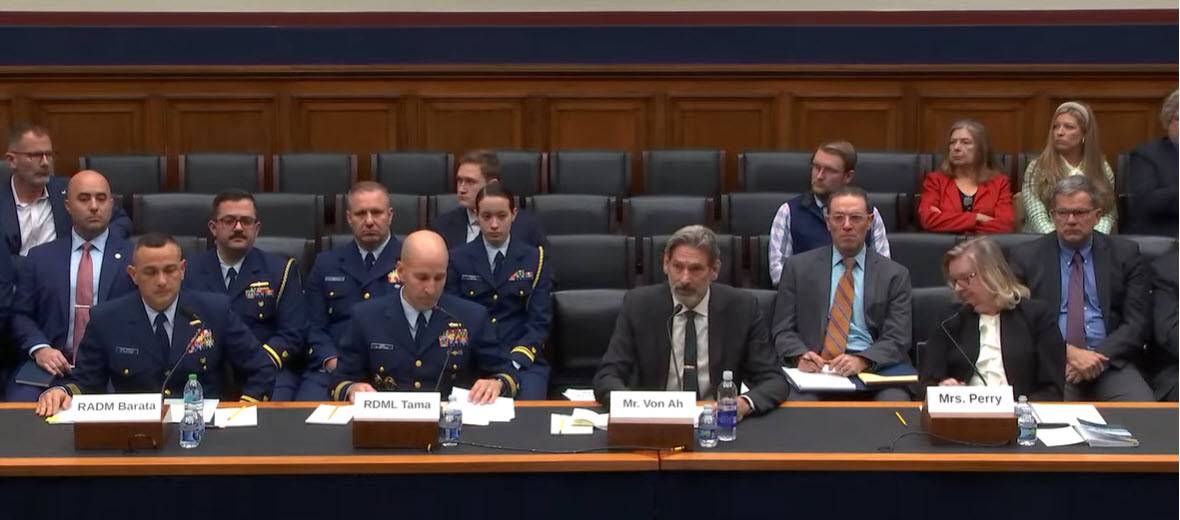
Andrew Von Ah, Director, Physical Infrastructure Testimony at the US Government Accountability Office, spoke before the Subcommittee on Coast Guard and Maritime Transportation in December highlighting the challenges faced by the US Coast Guard in furthering the development of autonomous shipping. “While autonomous ships offer a range of potential benefits, uncrewed or fully autonomous technologies could also present challenges to a U.S. legal framework that generally requires (or is written with a presumption that) crews will be onboard and in control of every ship.”
His work with the US Coast Guard identified that it has limited authority to reduce crew requirements due to various statutes. A primary statute establishing minimum crew requirements sets minimum numbers depending on the gross tonnage of the vessel and requires that each vessel have a credentialed master.
Other relevant statutory provisions include, for example, the requirement that the certificate of inspection issued to a vessel state the complement of officers and ratings necessary for safe operation.
“Coast Guard officials advised us that any statute based upon the assumption that humans are aboard the vessel may present challenges as human operators are removed from ships as autonomous ship use and technology progresses. Coast Guard officials said they currently do not have authority to waive these requirements for autonomous vessels outside of the limited scope of the at-sea rocket recovery pilot program.”
Additionally, Coast Guard officials said that incorporating new technology into an existing regulatory regime requires sufficient data and examples of the technology for the Coast Guard to evaluate, and that they have not evaluated sufficient examples thus far.
Additionally, they will need to determine how to adopt the forthcoming IMO autonomous ship regulatory framework within the U.S. legal framework.
“Officials told us the Coast Guard did not intend to amend domestic regulations or issue policy guidance for autonomous ships in advance of the IMO regulatory framework because harmonizing U.S. regulations will be more effective once the IMO framework is established.”
The IMO expects to adopt the framework on a non-mandatory basis in 2026 and to adopt a mandatory framework in 2030 that will be effective in 2032.
In the meantime, Magnet Defense completed its acquisition of Metal Shark this week, bringing together autonomous systems, artificial intelligence and established U.S. shipbuilding capacity to accelerate delivery of unmanned surface vessels for national security missions.
Also this week, Hanwha Defense USA, Hanwha Systems Co, and U.S.-based collaborative autonomy company HavocAI announced they will jointly develop 200-foot autonomous surface vessels.


