
Incorrect Alloy for Valve Mounting Studs Presents Failure Hazard
The U.S. Coast Guard recently conducted a marine casualty investigation into an uncontrolled release of isobutane from a 2-inch cargo tank pipe aboard a pressure barge certificated to carry flammable cargoes. The direct cause of the incident was traced to the failure of the studs of a ball valve installed on a cargo tank’s gauging pipe which sheared off and caused the ball valve to separate from the cargo pipe. The affected ball valve, manufactured by Ohio Valve Company, was supplied with four body studs for securing the manifold valve block to the valve body and stamped in a manner indicating compliance with American Society for Testing and Materials(ASTM) standard A193 Grade B8M (316 Stainless Steel). These body studs were purchased byOhio Valve Company from Jian Huang Enterprise Co., Ltd.
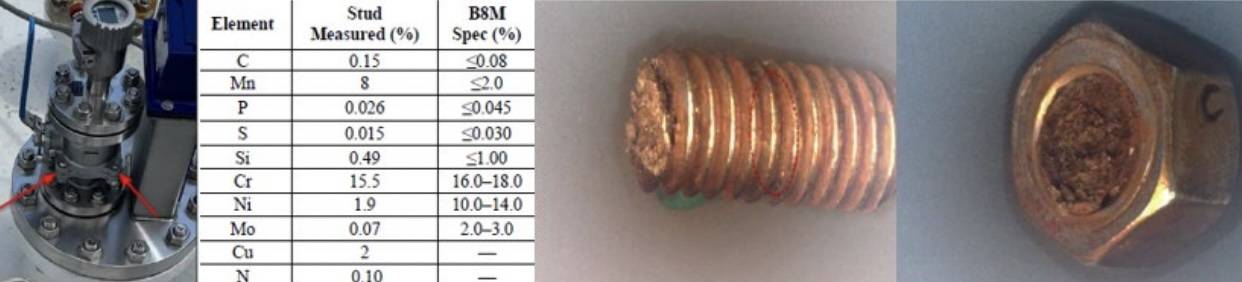
Metallurgical testing revealed that the studs were composed of non-conforming steel not meeting ASTM A193 Grade B8M, making them more vulnerable to stress corrosion cracking (see main photo) and premature failure. The use of this non-conforming steel in a marine and chemical environment, combined with tensile stress levels exceeding the material's rated strength, led to the failure of the studs.
A similar failure occurred in April 2025 which also resulted in an uncontrolled release of isobutane onboard a different pressure barge. In this incident, the same Class 300 2-inch ball valve model was involved, and metallurgical testing again confirmed the use of non-conforming studs as the cause of the incident.
The Coast Guard strongly recommends that owners/operators of pressure vessel bargescontaining flammable cargoes:
- Determine if any of the ball valves were manufactured by Ohio Valve Company.
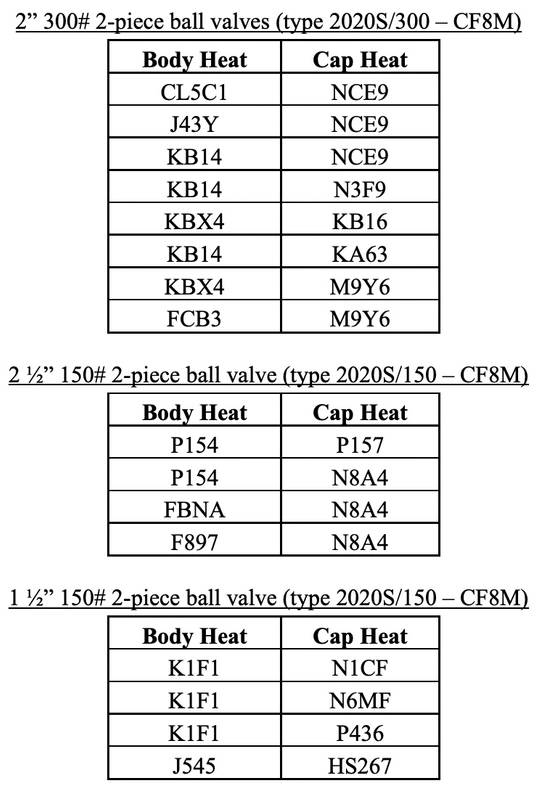
- If so, verify the Body Heat Number and Cap Heat Number on each of the ball valves installed. Cross-check the below listed cap and body heat number combinations against the ball valves installed on the pressure vessel. For the valve bolts to be affected, it must include both the corresponding Body and Cap heat number combination listed below. Since several different sized valves may use the same body/cap heat number combination, it is important to utilize the full list for each valve checked.
- Remove any affected ball valves from service as quickly and safely possible.
The Coast Guard strongly recommends manufacturers and distributors:
- Determine if they have received bolts from Jian Huang Enterprise Co., Ltd purported to be 316 stainless steel. If so, consider confirmatory testing to ensure the proper grade of stainless steel prior to installing or distributing for use on pressure vessels.

Below is an example of the body and cap heat number locations. Please note the valve in the picture is not an affected valve and only attached for illustrative purposes (see Figure 2).
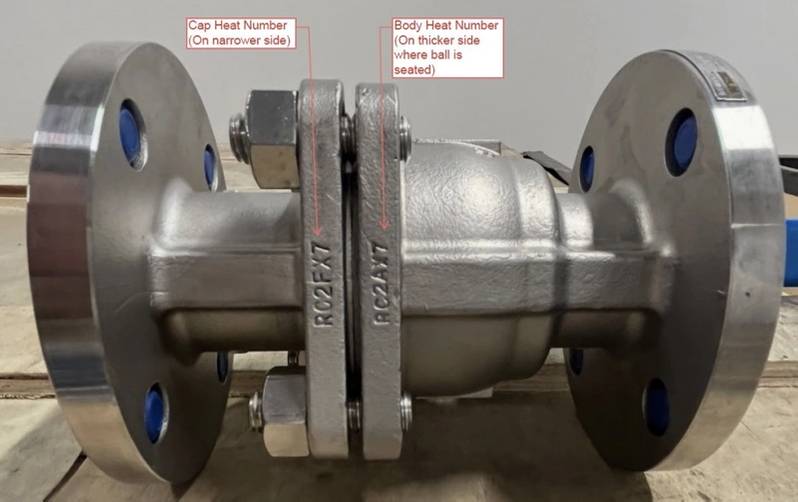 Figure 2. Credit: U.S. Coast Guard
This Safety Alert is provided for informational purposes only and does not relieve any domestic or international safety, operational, or material requirement. Developed by Sector Corpus Christi and distributed by the Office of Investigations and Casualty Analysis. Questions may be sent to HQS-SMB-CG-INV@uscg.mil.