

From the Lakes, on the Lakes & for the Lakes: Captain Paul C. LaMarre III


For Capt. Paul C. LaMarre III, the maritime industry isn’t a career choice as much as it is a family inheritance — and, in his words, “all I’ve known my entire life.” In a recent interview with Maritime Reporter TV, Captain LaMarre gives unique insights on the operating efficiently, effectively and safely on the Great Lakes system – the United States’ ‘Fourth Sea’ – and with passion, intellect and purpose advocates for a strong U.S. maritime industry.
A third-generation Great Lakes mariner, LaMarre’s earliest memories aren’t anchored to theme parks or campgrounds, but to the working waterfront: freighters and tugboats, the unmistakable mix of sights, sounds and smells that define the Lakes. His father spent 51 years with one of the main tugboat companies on the Great Lakes, is enshrined in the Great Lakes Maritime Hall of Fame, and is also known as a Great Lakes marine artist and company founder in the region’s shipping community.
That granite foundation — history, identity, and the lived reality of maritime commerce — is what LaMarre points to as the “foundation for everything else.” And it’s a theme he returns to again and again: an industry can’t chart its future without understanding the forces that built it.
LaMarre’s own path carries the same blend of tradition and reinvention. A graduate of California Maritime Academy, he served as a naval aviator flying off the West Coast before returning to the Great Lakes after a cancer diagnosis at a young age.
Back on freshwater, he joined the Toledo-Lucas County Port Authority, where he served during a period that would help shape how he thinks about ports, mission, and community impact: his work helping found the National Museum of the Great Lakes in Toledo.
From there, LaMarre took on what he describes as a “blank canvas” — a port with potential that had “spanned decades,” but which needed a purpose-driven push to become what it could be.
That port was Monroe.
The Port of Monroe: From “Pile of Dirt” to Regional Driver
LaMarre arrived at the Port of Monroe in 2012 — into a port that, as he puts it, hadn’t had a port director since 1978. “The port had essentially sat dormant,” he said, defined more by possibility than by cargo volumes and economic performance.
Today, he says the Port of Monroe carries an annual regional economic impact of roughly $85 million, tied to 520 direct jobs. The figure, he notes, can “ebb and flow based on the number of vessel calls per season,” but the broader story is less about a single metric and more about changing the port’s trajectory.
“I looked at the Port Monroe as a big train set,” he said, pointing to the realities of multimodal logistics and stakeholder alignment — and to the practical question that matters at any port: how do you improve infrastructure and get the system working as one integrated transportation unit?
The port’s business model, he says, has been deliberately maritime-first. “We operate the Port of Monroe as a non-for-profit,” LaMarre explained, contrasting the approach with ports that morph into “pseudo private economic and real estate development machines.”
Monroe’s focus, he says, is “strictly on maritime developing cargo to move people and vessels through the system,” with the goal of generating local tax revenue that ultimately “bolsters the quality of life” in Monroe and the surrounding region.
The proof, he argues, is visible during moments of stress — like the pandemic.
In 2020, while much of the world struggled to maintain normal operations, Monroe recorded its busiest season on record. LaMarre pointed to a specific project cargo run that handled 14 consecutive vessels — a sequence he described as producing roughly $14 million in regional economic impact from that cargo stream alone.
The transformation has also been personal. LaMarre jokes that his wife describes the port’s earlier state as “a pile of dirt.” Today, he says it is “seen as the most impactful regional economic driver” not only in the City of Monroe but across Monroe County and beyond.
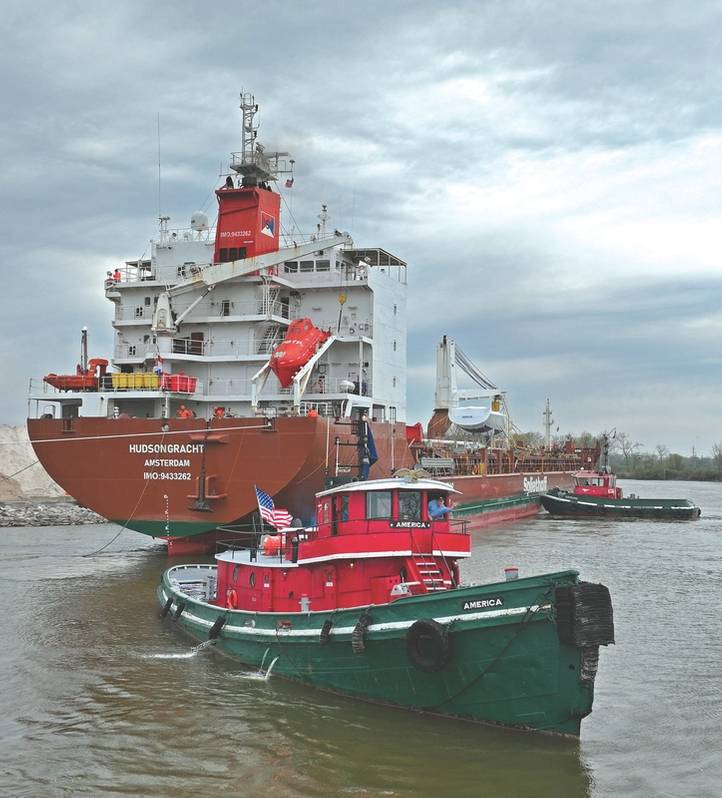 Capt. Paul C. LaMarre III waving from the wheelhouse of his beloved tugboat America, built in 1897 and still a productive working boat on the Great Lakes today.
Image courtesy AGLPA
AGLPA: Treating the Great Lakes as “One Port”
While Monroe’s story is a case study in reinvention, LaMarre’s broader platform as President of the American Great Lakes Ports Association (AGLPA) is about something even larger: positioning the Great Lakes–St. Lawrence Seaway system as a national economic advantage.
AGLPA represents 15 public ports throughout the Great Lakes system, while also strengthening relationships with private terminal operators, vessel operators and cargo owners as associate members. LaMarre’s framing is straightforward: the Great Lakes are “a direct line to the heartland of the United States,” enabling trade that can deliver “less congestion and less cost” as goods move into the Midwest.
One recurring challenge, however, is that the Great Lakes are hard to explain to people who haven’t experienced them.
“It’s hard to explain the Great Lakes,” LaMarre said. “Unless you’ve seen them… until you stand on the shores of Lake Superior or go through the Soo Locks on a thousand-foot lake freighter, it’s hard to imagine the magnitude of what we’re doing.”
And yet what moves across the Lakes is as American as it gets: “the raw materials that fuel industrial America,” including iron ore, coal, limestone and grain. LaMarre calls the Great Lakes “the fourth seacoast” — inland seas that are both working waterways and an industrial lifeline.
Investment, Icebreaking & Dredging
When LaMarre talks about policy, he doesn’t drift into abstractions. For him, it comes down to investment: in ports, in the system, and in the U.S. Jones Act fleet.
Grant programs such as the Port Infrastructure Development Program (PIDP), Marine Highway grants, and congressionally directed spending can be decisive — but Great Lakes ports, he argues, need their equitable share. He also flags the foundational needs that don’t make headlines but determine whether cargo flows: icebreaking, U.S. Army Corps of Engineers funding, and dredging backlogs.
The Great Lakes’ operating environment adds another layer. Weather is not just a variable; it can be a defining constraint. The lakes generate their own weather patterns, and LaMarre describes the sea state as uniquely punishing, with a shorter fetch producing shorter wave periods that can create “a very confused and violent sea” under significant weather.
He points to the Edmund Fitzgerald as the most famous Great Lakes wreck, and to the hard-earned safety lessons that have strengthened the system over time.
“Make Maritime Cool Again”
LaMarre doesn’t mince words on labor: the gaps are real, and the workforce is aging.
His answer isn’t a single program. It’s a cultural shift. “We need to make maritime cool again,” he said.
He points to “moments of inception” — the first time a kid stands in front of a ship, a locomotive, an airplane and feels that “larger than life” awe. In Monroe, the port hosted “Port Heritage Days” in 2023 without political speeches or sponsors, precisely to make the event about that spark — the early realization that transportation is foundational to everyday life.
He also argues the industry needs to stop underselling itself. Maritime isn’t only “hard work” and “operators,” though he’s proud of those roots. It is also technology, national resilience and service.
And yes, pay and lifestyle matter.
“Passion comes on the other side of the scale with pay,” he said, emphasizing the need to remain competitive with other transportation sectors while better communicating what maritime offers: time on/time off structures, opportunity, and mission.
Investments Ahead
For Monroe, LaMarre says what has remained constant is an identity he calls “the mariners port,” driven by the idea that people on the vessels and on the docks come first — and that relationships are the cargo that makes everything else possible.
That thinking informs the port’s development path today, including a major project: a new marine container terminal.
LaMarre says the Port of Monroe is nearing completion of Michigan’s first marine container terminal — a $19.5 million investment planned to come online in Q3 2026. The facility, he says, is positioned as the first “100% SAFE Port Act compliant” container facility, with 100% of cargo in and out screened and scanned — supported by infrastructure such as radiation portal monitoring, secondary inspection capability and CBP presence as the port becomes a port of entry.
Still, LaMarre is clear-eyed about what a Great Lakes container terminal is — and isn’t. In a world of 20,000-TEU ships on the coasts, the Great Lakes operate on different scale, with vessels closer to 650 TEU capacity. For Monroe, container capability supports a broader mission: “value over volume,” boutique operations, and the ability to stage complex projects that include breakbulk, heavy lift and specialized cargo. A theme LaMarre returns to: nimbleness.
Cargo trends, he warns, can shift quickly — even with “one social media post.” The days of long-term certainty can be elusive. Ports have to be ready for anything.
Port Security
When asked what keeps him up at night, LaMarre doesn’t start with fences or cyber platforms. He starts with cargo.
Specifically: losing critical cargo due to policy shocks.
He cites one example: Canadian steel coils moving through Monroe for the automotive industry — produced with U.S. iron ore — that went away completely due to tariffs on Canadian steel.
That kind of sudden change, he says, is a real risk in a bi-national system. His prescription is not denial, but collaboration: more harmony among ports, carriers and shippers, paired with investment and opportunity.
Maritime leadership, he argues, can still “tow the line” when it comes together — and the nation doesn’t need a war to rediscover its maritime identity and pride.
Tug America — Built in 1897 & Still Working
If the Port of Monroe is LaMarre’s modern canvas, the tugboat America is his living link to the past — and a working reminder of what maritime resilience really looks like.
Built in 1897, America is, LaMarre says, the oldest commercially operating tugboat in the world. She is “almost entirely original,” he notes, except for a repower from steam to diesel in 1950. Cable steering. Riveted hull. And still doing the job she was built to do.
LaMarre calls the tug the port’s mascot — a symbol of endurance on the inland seas.
And he’s not talking in metaphors alone. He describes occasions when America assists the Paul R. Tregurtha — a 1,013-foot Great Lakes giant — into Monroe. A vessel built for the scale of modern bulk commerce, aided by a tug designed in the era of wood schooners, steamers, and horses and carriages.
For LaMarre, it’s more than machinery. It’s the sensory core of the industry: “stale coffee, cigarettes, diesel, paint,” and the ritual of putting up a towline — the kind of detail only a working captain would choose to highlight.
“With each turn of her propeller,” he said, “we’re one further page into the history books.”
And if America stands as an example of what the industry has been — and what it can still be — LaMarre’s outlook is simple: “The future looks bright and strong.”


