

Meyer Turku: Cruise Vessel Demand Drives Strong Orderbook
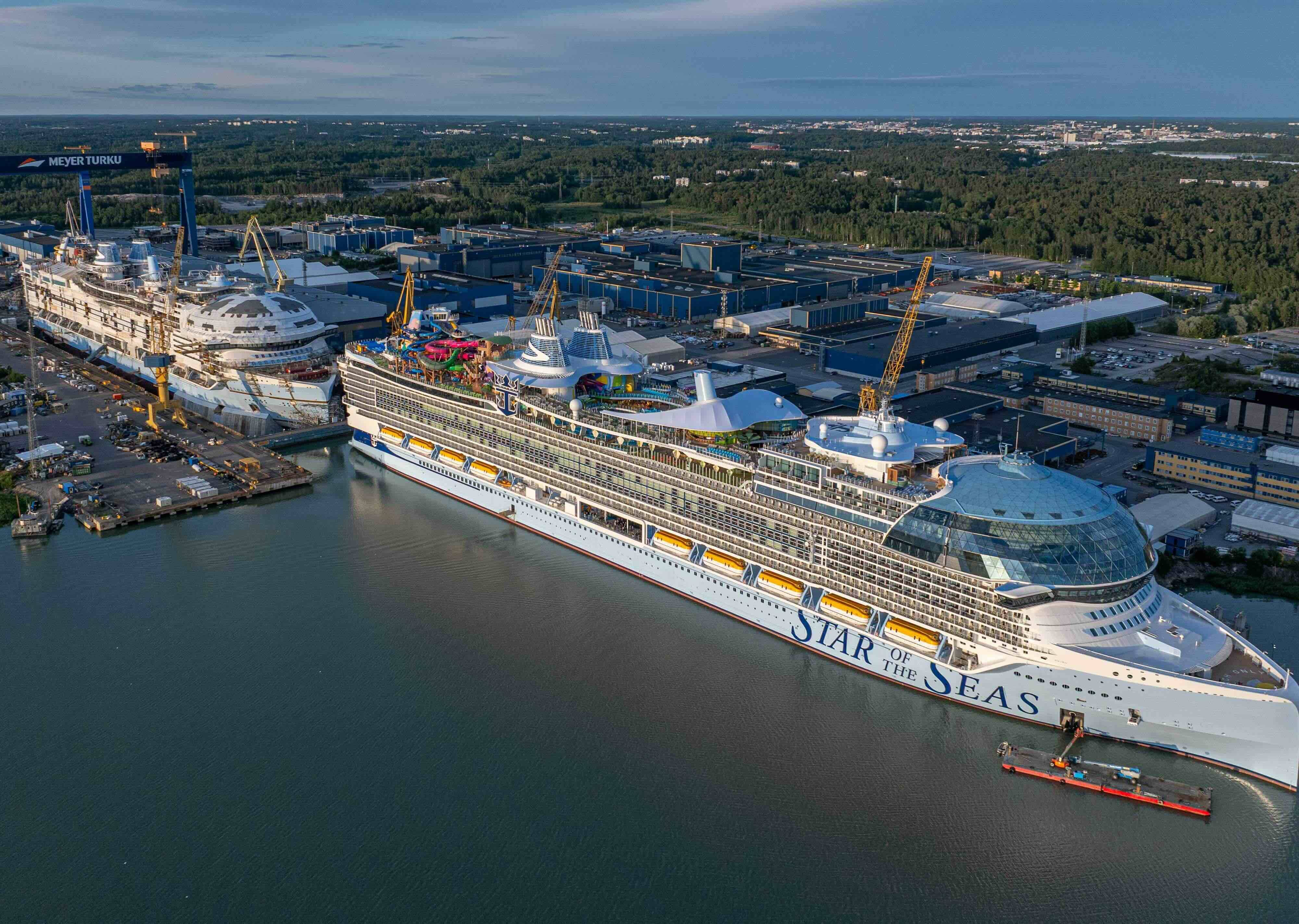
In the world of large cruise ship construction, few yards operate at the level of Meyer Turku, which recently unveiled its 2025 results which serve as a turning point, not just in financial recovery, but in long-term strategic positioning.
The numbers, at first glance, tell a familiar post-pandemic story. Turnover climbed to €2.14 billion, up more than 17% year-on-year, while adjusted EBIT reached €105.1 million, marking a continued recovery from losses just two years prior. But beneath the financials lies a more consequential shift: a yard restructuring itself for independence, stability, and a decade-plus of secured production.
The headline achievement in 2025 was the delivery of Star of the Seas, the second vessel in Royal Caribbean’s Icon class — arguably the most complex cruise ship series ever constructed. The significance here is less about the single delivery and more about what it represents: learning curve efficiency.
According to the CEO’s review, execution improved measurably compared to the prototype vessel, with the yard leveraging lessons learned to streamline production without sacrificing quality.
Today, work is progressing simultaneously on multiple Icon-class vessels, Legend of the Seas (Icon 3), Hero of the Seas (Icon 4), and a fifth vessel scheduled for 2028 delivery. The yard is effectively running a serial production model at the highest end of cruise ship complexity, delivering one vessel per year while building several in parallel.
Orderbook: Visibility Through 2036
If execution defines the present, the orderbook defines the future, and here Meyer Turku has quietly secured a strong position in global shipbuilding. A long-term framework agreement with Royal Caribbean extends construction rights at the Turku yard through 2036. This is more than a backlog. It is industrial visibility.
The agreement includes:
- Confirmed construction through Icon 5
- Options for Icon 6 and Icon 7
- A continuous production model built around three vessels under construction at any given time
While cruise ships remain the core business, Meyer Turku is not entirely a one-trick yard. The company is currently involved in the construction of two multi-purpose offshore patrol vessels for the Finnish Border Guard, scheduled for delivery in 2026 and 2027. This is not a pivot toward naval or offshore work in the traditional sense, but it does reflect a measured diversification strategy, one that aligns with growing geopolitical awareness across Europe.
Governments are increasingly focused on maritime security and domestic industrial capability. For a yard like Meyer Turku, participation in such projects strengthens its relevance within national and EU-level industrial policy discussions.
Strategy: Independence and Risk Rebalancing
Perhaps the most consequential development in 2025 is not what Meyer Turku built, but how it plans to build going forward. The company has repositioned itself as a more independent entity, with strengthened governance and a clearer strategic framework aimed at long-term financial resilience.
Central to this shift is a new financing model introduced with Icon 4, which places primary financing responsibility with the customer rather than the yard. For shipbuilders, this is a significant evolution. Historically, yards have carried substantial balance sheet risk tied to project financing. By shifting that burden, Meyer Turku is effectively: reducing financial exposure, improving capital efficiency, and creating a more stable earnings profile.
Opportunity Meets Uncertainty
The outlook for Meyer Turku, and the cruise shipbuilding sector more broadly, is shaped by a mix of strong demand fundamentals and persistent external risks. On the positive side:
- Cruise passenger volumes continue to grow, albeit at a more normalized pace
- Fleet renewal cycles are underway across major operators
- Demand for larger, more technologically advanced vessels remains robust
But the headwinds are equally real. Geopolitical tensions are reshaping global supply chains and shifting industrial priorities. Europe, in particular, is placing renewed emphasis on strategic industries like shipbuilding, with both EU and national-level maritime strategies emerging.
At the same time, competition is evolving. While European yards still dominate large cruise ship construction, Chinese shipbuilders are making incremental gains, supported by state backing and long-term industrial policy. Layer on top of that supply chain fragmentation, labor market constraints and increasing regulatory complexity, particularly around emissions, and the operating environment becomes considerably more complex.
To navigate this landscape, Meyer Turku is investing—deliberately and at scale. A four-year, €150 million investment program is underway to modernize the yard, increase capacity, and improve productivity. This runs in parallel with an improvement program of similar scale, aimed at enhancing operational efficiency and competitiveness. The logic is straightforward: in a market defined by a small number of very large, very complex projects, execution is everything. Margins are won or lost on the shop floor, not in the sales office.


