

Op/Ed: Arctic Ice is a U.S Shipbuilding Thermostat – Let’s Turn Up the Heat

In December of 2025, the U.S. Coast Guard announced the award of two contracts to build up to six Arctic Security Cutter (ASC) icebreakers. The announcement declaring the vessels would be built between the United States and Finland in a major step forward for America’s national security in the Arctic region. The decision process encompassed more than the security of the Arctic passage. It announces a major shift in the U.S. Shipbuilding process. A second round of contracts were approved February 11, 2026 involving Davie in Canada and its recently purchased shipyard facility in Port Arthur, Texas under a similar agreement and process.
The initial contracts were awarded to Rauma Marine Constructions Oy of Rauma, Finland, and Bollinger Shipyards and are the result of the Federal Administration’s collaboration with Finland. The “foreign” built deliveries will prove to be an historic move in reestablishing U.S. shipbuilding.
The recent Maritime Action Plan (MAP) describes the “allied” construction partnerships as a “Bridge Strategy.” ICEPACT already includes plans with Japan and Korea.
The contract with Rauma Marine Constructions Oy includes up to two ASCs to be built in Finland, with delivery of the first vessel expected in 2028. The contract with Bollinger Shipyards includes up to four ASCs to be built in the United States, with delivery of the first domestically built cutter expected in 2029. Rauma designs roughly 80% of worldwide icebreakers and builds approximately 60% of international breaker tonnage. The collaboration between the two yards is designed to take immediate advantage of Finland’s icebreaker expertise while coordinating the follow-on construction in the United States with a solid supply chain. More importantly it meets 2028 timing to place U.S. breakers in the water and NATO’s “Arctic Sentry” increased military presence of NATO allies in the region.
The contract process goes beyond National Security and reaches into the current U.S Shipbuilding debate. Where historical U.S. construction begins prior to completing a full production design, this program allows the domestic icebreakers to be built from a fully completed and modeled design package with the capability of U.S. Vessel Construction Managers attending during the construction. A cooperative educational experience and again corrective actions discussed in the MAP.
As our domestic industry highlights the urgent need for skilled shipbuilding labor, the ASC program has been supported by the U.S. Department of Labor (ILAB) through the International Workforce Development Initiative to provide sustainable, quality training paths along with integrating Finnish shipbuilding practices utilized during the ASC construction program.
The NEXTSEAS program is developing partnership arrangements with Satakunta University of Applied Sciences addressing engineering, robotics, and automation training. Länsirannikon Koulutus Oy WinNova is building shipbuilding skills of welding, machining, electrical, rigging and safety while Massachusetts Maritime Academy is the U.S. curriculum partner translating the Finnish practices to U.S shipbuilding opportunities and aligning the training with Rauma Marine Constructions advanced production practices to suit our industry needs.
While we debate shipyard capacity, greenfield development and “shipyards of the future”, this forward-thinking decision by the current Administration and the USCG prior to the MAP releases is addressing true shipbuilding problems and gathering experienced partners to expedite our maritime capabilities.
The Amtech Network has commercial “Ice Class” construction and repair experience along with Ice operations in Alaska, St Petersburg, Russia, the Great Lakes and Nova Scotia. We are prepared to support the ASC program. More importantly it is our opinion the U.S must look to understand the new northern passage market well beyond military involvement.
 ILS Ship Design & Engineering in Helsinki, Finland has developed the ILS Removable icebreaker bow concept - DIBB. The removable bow icebreaker is based upon utilizing an existing tug with lower power and size than a conventional icebreaker. The tug is connected it to a notched removable ice breaking bow with additional port and starboard propulsion system adding the additional power to push and break ice. When the bow is not in use, the existing tug in the notch can return to primary operations. Image courtesy ILS Ship Design & Engineering
Commercial Shipbuilding: Lessons Learned
So where are the “lessons learned” as it relates to U.S. commercial shipbuilding.
Worldwide geopolitical events in Venezuela, Suez, and the Panama Canal coupled with a sanctioned Russian ghost fleet have created more than elevated interest in the Northern Sea Route along Russia’s Arctic coast. The larger Northeast Passage and Canada’s Northwest passage also provide seasonal transportation as the far north is warming nearly four times faster than the global average. Continued “ICE” discussions will extend that seasonal market as the route can become more viable when compared to the issues the long-term geopolitical events present. The projected cargo tonnage capable of moving through the Arctic passage has been compared to levels moving through the Suez Canal.
This is a market and transportation initiative U.S flag tonnage is not prepared for and it will require commercial and private investment well beyond USCG icebreakers.
Russia’ latest Ice class LNG vessels are idle due to sanctions. Four of Russia’s eight Nuclear Icebreakers are newly constructed. The U.S flag has nearly ZERO ice class commercial vessels, private ice classed tugs or escort icebreakers.
The description of “Ice class” or “ice capable” is misunderstood in many applications. It is not only the bow or wind & water scantlings of the side shell. Propulsion, rudders, propellers and shafting capabilities are taken into account to satisfy the selected Ice Class the vessel is trying to meet: Canadian, Norwegian, Finnish or Arctic and their designations; CAS 1-4, Arctic 1- 10, or 1A Super to 1C lowest.
The decisions process is more confusing than selecting an Italian ICE flavor at a Kiosk during a Brooklyn, New York Italian Festival!
As the Administration shipbuilding efforts continue, seasonal ice and transportation in the Great Lakes region will also enter into new discussions. The American Great Lakes Ports Association recently announced a market analysis focused on expanding cargo shipping between the Great Lakes and inland waterways with the Ports of Indiana, Milwaukee, Chicago and Detroit all showing interest in supporting a new supply chain.
The study will seek to find ways to expand cargo transfers while assessing infrastructure needs and ways to improve terminal operations. As the Amtech, Vega Reederei and Conoship partnership prepares to announce the construction of a U.S. East Coast and Great Lakes series of microcontainer feeders, the issue of seasonal ice in the lakes will becomes part of a market analysis. The successful transshipment of containers cannot sit out a four-month winter idle period. The development of the new market will require icebreaker escort support. Finnish technology can also assist in defining this effort and supporting current existing US-flag tugboat tonnage.
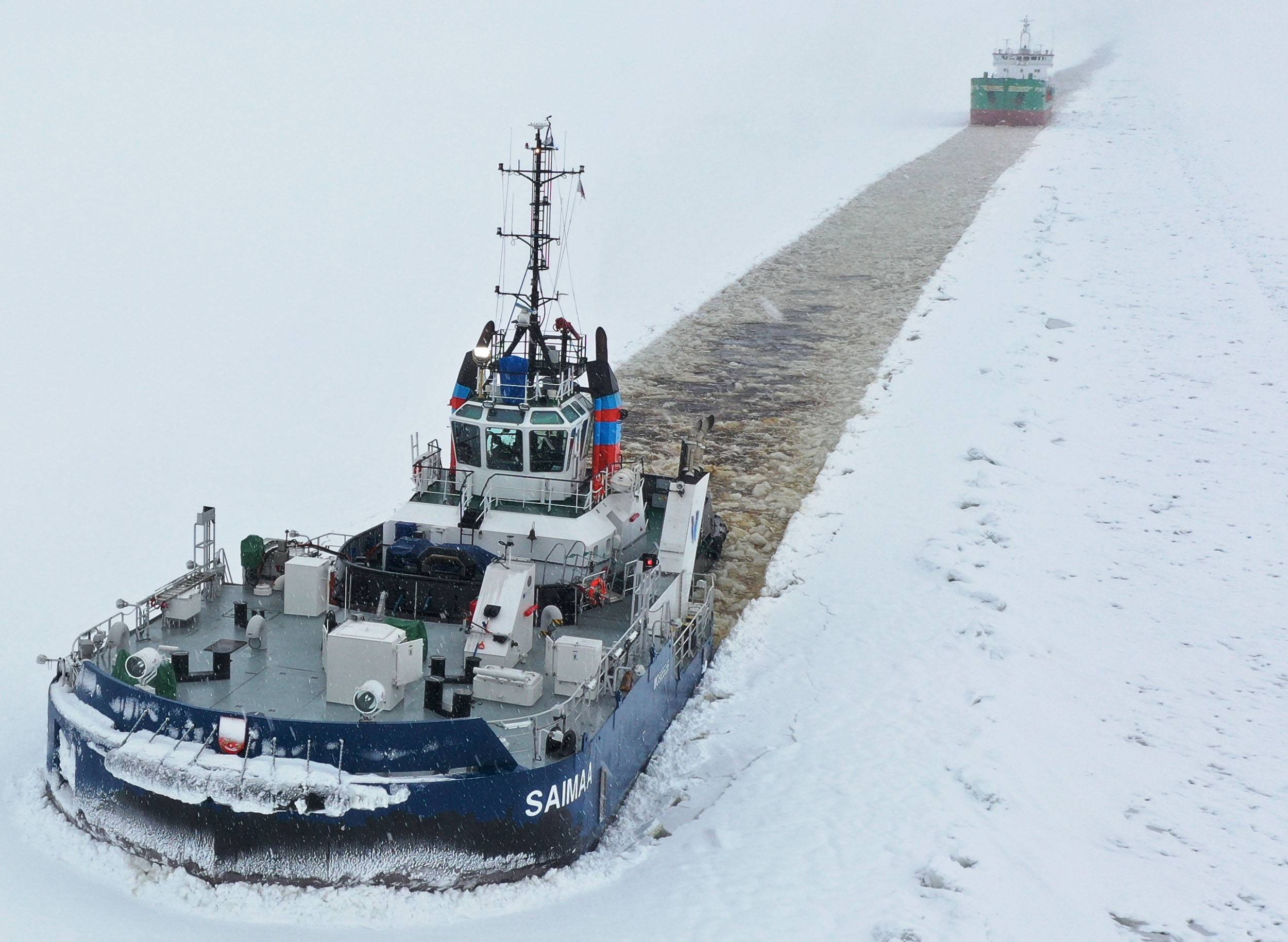
ILS Ship Design & Engineering in Helsinki, Finland has developed the ILS Removable icebreaker bow concept - DIBB. The removable bow icebreaker is based upon utilizing an existing tug with lower power and size than a conventional icebreaker. The tug is connected it to a notched removable ice breaking bow with additional port and starboard propulsion system adding the additional power to push and break ice. When the bow is not in use, the existing tug in the notch can return to primary operations.
The “system” is similar to our U.S. ATB designs using Intercon pins and ladders (https://intercon.com/tug-barge-couplers-2/) to mate tug and barge. Alfons Håkans (We Make It Happen - Alfons Håkans) currently operates one of the units in the Gulf of Finland and the Port of HaminaKotka (Hamina, Finland). Its Tug Calypso is used for general ship assist activity when not attached to the ice breaking bow and providing ice breaking services. Larger units have been designed capable of breaking 1.5-meter-thick ice at Super 1A levels. Intercon management attended the Alfons Håkans operation and we thank them for the photos, updates, and discussions. These commercial efforts strengthen our entrance into the market as the Arctic opens up.
The investment savings are obvious when comparing the cost of commercial new construction ice breaking tonnage. More importantly it illustrates not only a new commercial collaboration with an experienced designer, builder and operator but also another example of opportunities that can exist under the MAP “Bridge Strategy”markets and opportunities that include U.S. smaller second tier shipyards that continue to build and serve the U.S domestic shipbuilding industry. We may be still debating global warming, alternative fuels and energy. Until those issues are solved these examples look like “ICE, ICE Baby.”
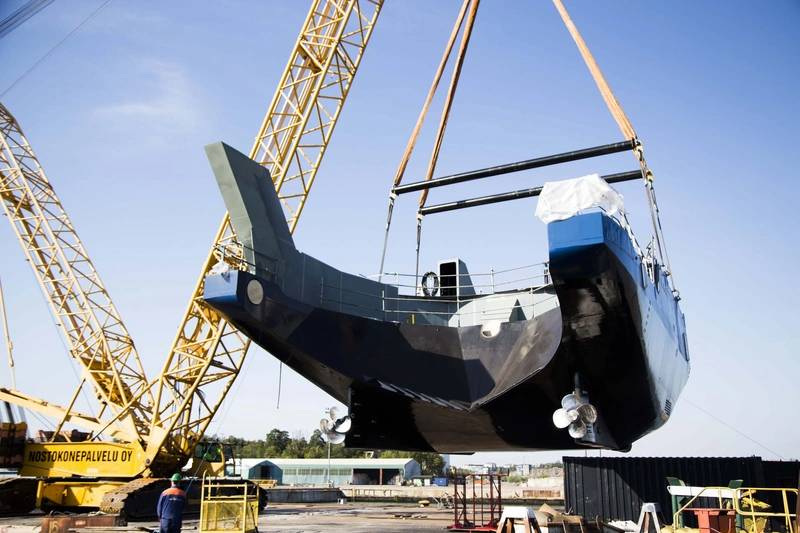 Image courtesy ILS Ship Design & Engineering
 Image courtesy ILS Ship Design & Engineering


