

Robert Allan Ltd. Signs Contract for TundRA 3100 Icebreaking Tug for Swedish Port
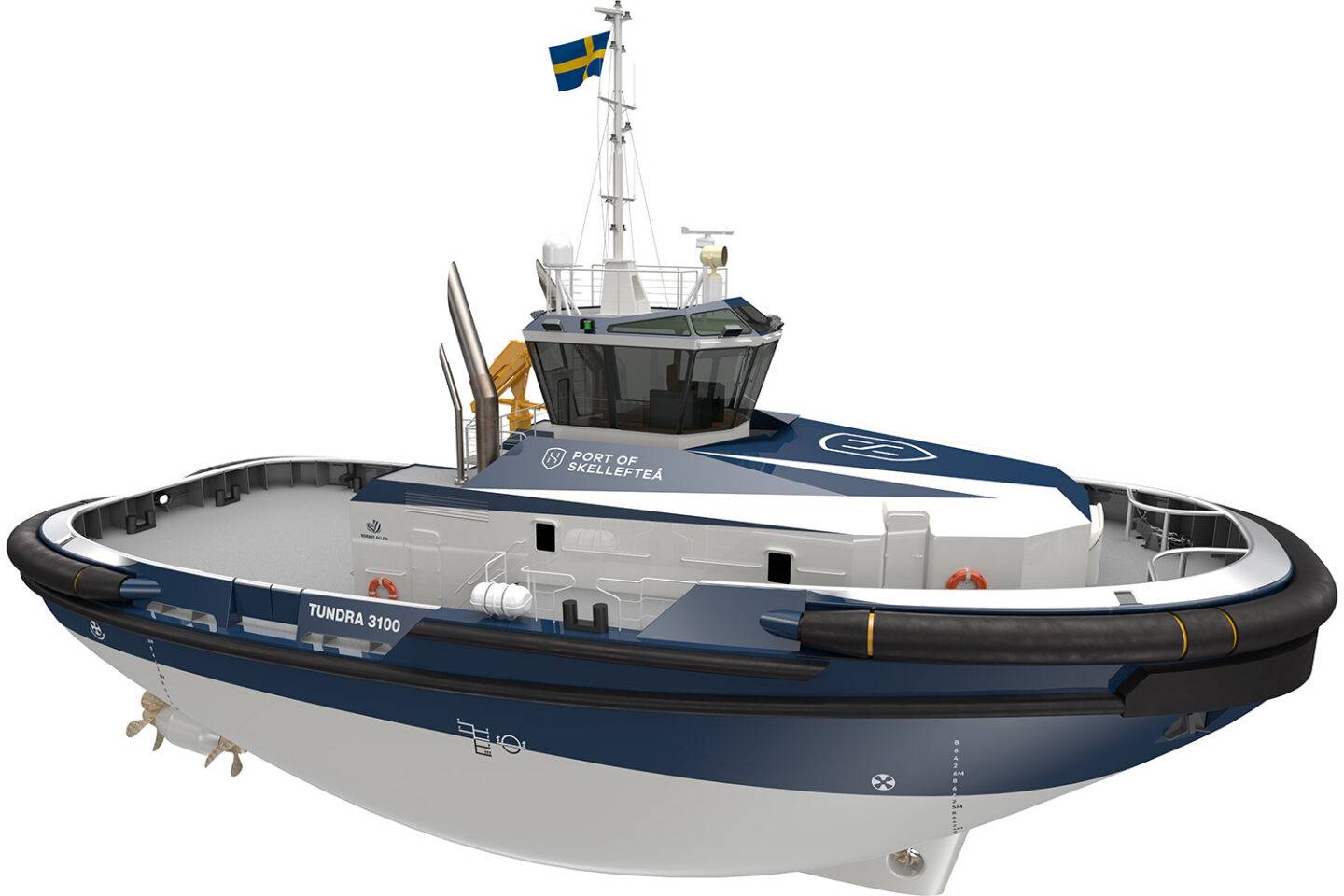
Robert Allan Ltd. is has announced the signing of a new contract in November 2025 for the design of a TundRA 3100 icebreaking tug for the Port of Skellefteå, Sweden. This latest addition to the TundRA series is specifically engineered for the demanding conditions of Arctic and sub-Arctic ports, offering exceptional capabilities for icebreaking, ship assist, and escort services.
With the TundRA 3100, the Port of Skellefteå will benefit from enhanced ice management capabilities, reduced winter downtime, and improved safety for vessels operating in icy waters. The tug’s design and icebreaking performance make it an ideal choice for supporting the growth and resilience of northern ports that face challenging ice conditions.
The vessel will be equipped with electrically driven azimuthing propulsors, an electrical battery energy storage and a diesel power generation plant. The flexibility offered by this electric powering system will let the tug perform some ship assistance operations on electrical battery power alone without engaging diesel engines. This will save fuel, cut emissions, and reduce maintenance costs.
The RIM-Drive tunnel thruster will allow for heading control during buoy-tendering/fairway management duties.
Key TundRA 3100 Particulars:
Length overall: 30.5 meters (excluding fenders)
Breadth: 12.8 meters
Draft navigational: 5.6 meters
International gross tonnage: 495 (approx.)
Accommodation: 6 persons
Fuel oil: 110 m3
Potable water: 10 m3
Bollard pull: 60 tons minimum
Icebreaking performance: breaks up to 1.0-metre-thick ice with speed of 2.5 knots
The compact (under 500 GT) TundRA 3100 is designed to break ice efficiently using a combination of a powerful and effective propulsion system and an advanced hull geometry methodically developed from previous Robert Allan Ltd. icebreaking designs. The hull geometry for the TundRA 3100 is proven from both model testing and lessons learned from accumulated operational experience from previous TundRA vessels. Propelled by a pair of electrically driven contra-rotating propulsors, the tug can operate in challenging ice conditions to ensure safe and reliable port operations throughout the winter season.
Model-scale ice breaking testing played a crucial role in validating the icebreaking performance of the TundRA 3100. Testing was conducted at the National Research Council of Canada’s (NRC) Ocean, Coastal and River Engineering Research Centre’s facilities in St. John’s, Newfoundland and Labrador, in July 2023, with valuable advisory services and financial support from the National Research Council of Canada Industrial Research Assistance Program (IRAP).
A key question to answer was how ice performance was affected by the hull shape and interaction with propulsors. For the TundRA 3100, the hull shape was optimized for operation in the extreme climate conditions and ice-infested waters of the northern Gulf of Bothnia on the basis of previous experience, model tests, and feedback from operators.
Another goal was to verify and optimize the performance of the hull-propulsor system under icebreaking conditions. The TundRA 3100 is equipped with ice-capable azimuth propulsors with contra-rotating propellers. With two propellers per propulsor, the thrust is at least 10% greater than that produced by a single propeller Z-drive of the same diameter. This can make a significant difference in icebreaking performance.
Tests confirmed that this relatively small 30.5 m long TundRA 3100 can break 1.0 m thick ice at a speed of 2.5 knots. When going astern, the TundRA 3100 can break 0.7 m thick ice at a speed of 2.0 knots. This level of the astern icebreaking performance is impressive for such a compact icebreaking vessel.
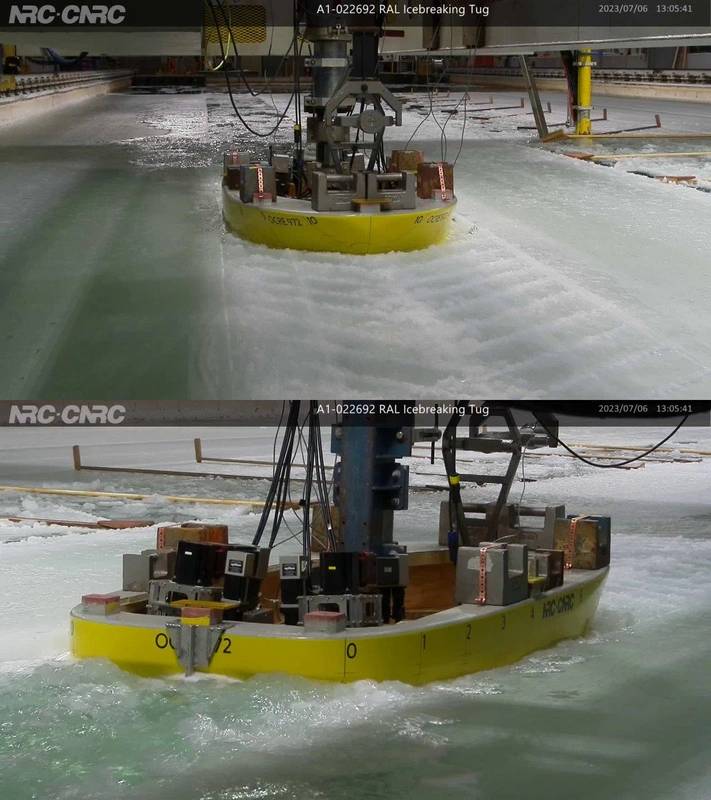 Model-scale ice breaking tests at the National Research Council of Canada’s Ocean, Coastal and River Engineering Research Centre’s facilities. Credit: Robert Allan


