

Robustel MG460 Platform Achieves ClassNK Type Approval
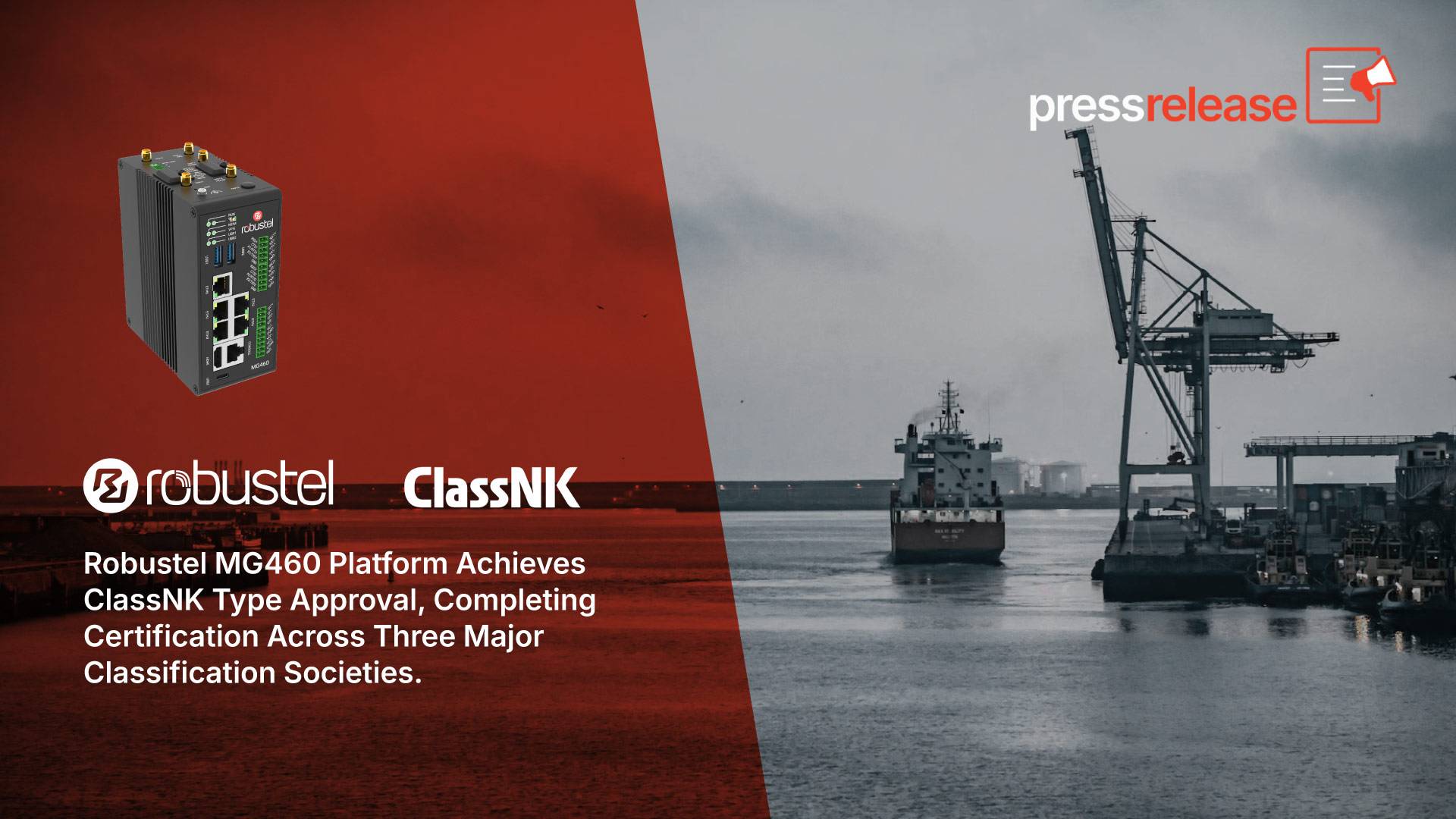
Robustel’s MG460 Gateway and MG460 Forwarder have received ClassNK Type Approval as a Computer-Based System (CBS) under IACS UR E27. Issued under Approval No. 26CY029, the approval is valid until 23 April 2031.
Robustel is a global provider of industrial connectivity and edge computing solutions, headquartered in Guangzhou, China. Founded in 2010, the company develops routers, modems, edge computing gateways, and purpose-built networking products for industrial and maritime applications.
Robustel's maritime product portfolio is engineered for regulated and safety-critical environments, supporting secure shipboard networking, controlled vessel-to-shore communication, and cyber-resilient maritime system integration. The company serves maritime OEMs, shipyards, system integrators, and vessel operators worldwide.
The ClassNK approval completes a certification across three of the world's leading maritime classification societies — joining existing approvals from DNV and the China Classification Society (CCS) — and confirms Robustel's position as a class-approved supplier for shipyards, system integrators, and vessel operators building cyber-resilient network architecture.
Cyber risk management has become a formal part of maritime safety management under the SOLAS/ISM framework. IMO Resolution MSC.428(98) requires approved Safety Management Systems to address cyber risk in accordance with the objectives and functional requirements of the International Safety Management Code — establishing the operational foundation on which classification society cyber resilience requirements now build.
IACS UR E26 and UR E27 translate that obligation into class requirements for applicable newbuild projects, and have been mandatory for vessels contracted from 1 July 2024. UR E26 addresses cyber resilience at the vessel level — defining what a compliant ship architecture must demonstrate overall. UR E27 applies to individual onboard systems and equipment, setting the security requirements that component suppliers must meet. Together, they create a two-tier compliance structure: shipyards and integrators are accountable for vessel-level architecture under E26, while equipment manufacturers must demonstrate conformance at the component level under E27.
ClassNK Type Approval of the MG460 Gateway and MG460 Forwarder under UR E27 means both products have been independently reviewed and verified against the cyber-resilience requirements now shaping maritime system design. For shipyards and system integrators working toward vessel-level approval, pre-certified equipment strengthens the compliance position from the start of the architecture and documentation process — reducing uncertainty at the system design stage and simplifying the evidence base required during class assessment.
The MG460 platform was developed specifically for IEC 61162-460 network environments. IEC 61162-460 is the IEC standard governing the safety-critical, isolated networks used for navigation, bridge, and related systems aboard commercial vessels. It mandates strict logical and physical separation between these protected systems and all other vessel networks — a requirement that is straightforward to state and demanding to implement correctly in a connected vessel architecture.
The challenge in these environments is not moving data around the vessel; it is enabling authorised data exchange across controlled boundaries without weakening the segmentation the standard requires. The MG460 Forwarder is designed specifically to support controlled exchange between IEC 61162-460 domains and authorised vessel systems, maintaining the separation the standard demands while allowing approved data flows to proceed. The MG460 Gateway extends that principle to the vessel boundary, providing secure, structured control over vessel-to-shore communication. Together, they help integrators build cyber-resilient network architectures around the real constraints of regulated maritime environments — rather than adapting general-purpose industrial connectivity hardware to fit after the fact.
While vessel-level compliance remains dependent on the complete ship architecture, integration, documentation, and class review process, approved equipment provides a verified foundation that class societies and integrators can build from with confidence.
Platform Capability
The MG460 Gateway provides a secure boundary between onboard vessel systems and external networks, enabling controlled vessel-to-shore data transfer through multi-layer firewalling, interface-level security policies, encrypted tunnels, and a demilitarised zone for managed file and service exchange. It is designed for environments where operators need to export approved data without exposing critical bridge or operational networks to external access.
The MG460 Forwarder manages secure, structured data exchange within the vessel, connecting IEC 61162-460 domains and authorised shipboard systems while maintaining segmentation, traffic prioritisation, and policy-based separation. For vessel architectures where navigation, automation, monitoring, and reporting systems must share information without weakening the overall cyber posture, the Forwarder provides a controlled internal data-forwarding layer that supports class-aligned cyber-resilient architecture.
Together, the two products form a shipboard networking platform designed to support the security architecture that modern classification rules and vessel operators require.
"Class approval is not a marketing exercise," said Desmond Kuang, General Manager of Robustel's Maritime Business Unit. "It requires documented security architecture, tested procedures, and ongoing maintenance obligations. Having that work independently evaluated by DNV, CCS, and now ClassNK reflects the level of engineering discipline the maritime industry should expect from its connectivity vendors. The MG460 platform was built specifically for shipboard environments, not adapted for them. Every connection should be controlled, auditable, and appropriate for the systems it touches — and independent certification is how we demonstrate that commitment with evidence, not assertion."


