

MITSUI E&S Commercializes Ammonia Dual Fuel Engines

MITSUI E&S has completed the commercialization of large ammonia-fueled marine engines and ammonia fuel supply systems, the only Japanese manufacturer to do so.In February 2026, MITSUI E&S conducted land-based tests involving the integrated operation of the ammonia dual fuel engine MITSUI-Everllence B&W 7S60ME-C10.5-LGIA-HPSCR which was witnessed by ClassNK. This verification confirmed the engine complied with the IMO’s NOx regulations.MITSUI E&S has already decided to expand its…
CMT Launches Engine Pressure Drop Tester for Ship Operators

Germany's CM Technologies (CMT) has launched a compact pressure drop testing instrument designed to help ship operators detect cylinder pressure leaks early, enabling them to address engine wear before it leads to higher fuel consumption, costly repairs and vessel downtime.The Pressure Drop Test Instrument (PDTI) measures pressure loss in diesel engine cylinders during the compression process, helping engineers identify issues such as worn piston rings, cylinder liner wear or…
WinGD Books Engine Order for 12 Dynacom's VLCC Newbuilds

Swiss marine engine designer WinGD has secured an order to supply main engines for 12 very large crude carriers (VLCCs) being built at China's Hudong-Zhonghua Shipbuilding for Greek tanker owner Dynacom.Each vessel will be fitted with a WinGD 6X82-2.0 low-speed engine, alongside exhaust gas scrubbers and high-pressure selective catalytic reduction (SCR) systems to meet current International Maritime Organization emissions requirements.The order comes as tanker owners continue to invest in modern…
Caterpillar MaK Engines Receive Dual-Fuel Conversion Solutions

Caterpillar announced new alcohol-based fuel conversion solutions for MaK engines. The dual-fuel conversion, for M 43 engines, is engineered to operate on up to 95% methanol or ethanol by volume which lowers greenhouse gas (GHG) emissions up to 80%. The fuel-blending conversion allows operators to blend up to 35% methanol or ethanol with marine diesel oil (MDO), marine gas oil or biofuel equivalents to deliver GHG emissions reductions up to 20% for M 20 to VM 43 engines[i]. Both…
VPS: Abrasive Catfines Can Damage Marine Engines

A common concern of maritime chief engineers, regarding vessel engine damages, is the presence of highly abrasive “catfines” within marine fuel. To fully understand the seriousness of this issue, we first need to understand the source of the problem.Oil refineries use catalysts in their Fluid Catalytic Cracking Units (FCCU) or “Cat Plants” to process crude oils in the production of numerous products from the source crude. These catalysts are high in aluminum silicate (Al+Si) content and over time and repeated use, can breakdown and fragment into smaller particles, or catalytic fines.
Accelleron Launches ACCX300-L Turbocharger

Accelleron announced the commercial launch of the ACCX300-L, its low-speed turbocharger for two-stroke marine engines, designed to help shipowners adapt to evolving operating profiles, fuels, and emissions requirements. Combining a new service‑friendly cartridge concept, a simplified platform architecture, and integrated digital capability, the ACCX300‑L decouples turbocharger maintenance from drydock schedules while delivering long‑term efficiency, flexibility, and uptime across…
Japanese Firms Advance Hydrogen-Fueled Engine with Full-Scale Trial

Japan’s Japan Engine Corporation and Kawasaki Heavy Industries have begun hydrogen co-firing operations on a full-scale main engine designed for large commercial vessels, marking a step toward the development of hydrogen-powered shipping.The work forms part of a government-backed project under New Energy and Industrial Technology Development Organization, with participation from Mitsui O.S.K. Lines (MOL), MOL Drybulk, Onomichi Dockyard and ClassNK.The companies said the engine…
CIMAC Report Reminds on New fuel Safety Risks
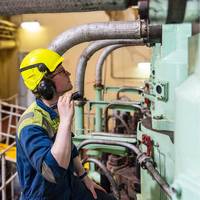
CIMAC Working Group 17 (Gas Engines) has just released a new guideline that provides a comprehensive overview of how alternative fuels such as hydrogen, ammonia, methanol, and ethanol can be used in modern stationary and marine gas engines.Under the safety concepts chapter, it states: “New fuels need new skills, so personnel need to be trained to handle the new fuels.”The report includes a summary of potential risks to humans.Anhydrous ammonia is a hygroscopic compound, meaning it actively seeks water from the nearest source, including the human body.
Due Diligence Required as More Biofuel Feedstocks Used

NorthStandard has published a new white paper focusing on the accelerating adoption of biofuels in commercial shipping. ‘Biofuels – Driving the green transition’ brings together insights from NorthStandard, supplier World Fuel and leading testing agency Veritas Petroleum Services (VPS), in a unique discussion document outlining biofuel uptake, potential issues and loss prevention measures. Many owner-operators who seek a drop-in solution to drive maritime decarbonization choose biofuel blends.
Everllence Develops Hydrogen-Capable 4-Stroke Test Bench

A research-engine test bench at Everllence’s Augsburg site has been upgraded to enable hydrogen combustion.The new development occurred under the umbrella of the HydroPoLEn project, an Everllence partnership with industry leaders and research institutes. The project is supported by funding from the German Federal Ministry for Economic Affairs and Energy within the framework of the Maritime Research Programme.HydroPoLEn is focused on creating sustainable propulsion solutions for the maritime sector, addressing the urgent need for environmentally-friendly technologies in global shipping.
Everllence and Vale Sign Ethanol Cooperation Agreement

Everllence and Vale – one of the world’s leading producers of iron ore, copper and nickel, and one of the largest logistics operators in Brazil – have signed a cooperation agreement regarding the development of ethanol as a marine fuel.Under the terms of the agreement, the companies will develop an advanced ethanol-powered engine – based on the Everllence B&W ME-LGI (-Liquid Gas Injection) platform – designed to provide a sustainable and viable alternative to conventional fossil…
Yanmar Prepares for Hydrogen Engine Production

Yanmar Power Solutions has acquired a site in Amagasaki City, Japan, to conduct test runs of marine hydrogen engines.The company says it will develop and build powertrains that can be used with next-generation fuels such as hydrogen, methanol, and ammonia, at the new facility.The complex will enable the company to reorganize its production system, including existing factories, and strengthen its capabilities. It is scheduled to begin operations around March 2029.
Skarv Shipping Opts for Wärtsilä’s Ammonia Solution for New Cargo Vessel

Technology group Wärtsilä will supply its Wärtsilä 25 ammonia solution to power a new cargo vessel for Norway-based Skarv Shipping Solutions, marking the first newbuild to use the company’s four-stroke ammonia engine technology.The vessel will be constructed at Huanghai shipyard in China and is intended to support Skarv Shipping Solutions’ strategy to deliver sustainable short-sea shipping services in Northern Europe.Wärtsilä will provide the Wärtsilä 25 Ammonia engine together with the complete fuel gas supply system and exhaust after-treatment…
HHI-EMD Runs Four-Stroke on Ethanol at Full Load

HD Hyundai Heavy Industries, Engine & Machinery (HHI-EMD) has successfully verified that its HiMSEN engine can operate stably on ethanol fuel.The company conducted the tests on its 4-stroke methanol dual-fuel engine platform (H32DF-LM) and confirmed that stable operation at all load points is possible. The test focused on verifying startability, combustion stability, power output stability, and exhaust gas characteristics under fuel property differences, while maintaining the existing methanol engine hardware as much as possible.Ethanol…
Newlight Completes RINA FAT for Hydrogen Retrofit
Newlight has completed Factory Acceptance Testing (FAT) for its hydrogen retrofit package for two- and four-stroke main engines.The system allows existing diesel engines to operate on a blend of hydrogen and conventional fuel, reducing carbon emissions without the need to replace the entire engine.Designed and built to the International Code of Safety for Ship Using Gases or Other Low Flashpoint Fuels Code (IGF Code) and validated to RINA Class Rules for hydrogen fueled ships…
Consortium Achieves First Land-based Operation of Marine Hydrogen Engine

Kawasaki Heavy Industries, Ltd., Yanmar Power Solutions Co., Ltd. and Japan Engine Corporation announced they have successfully conducted the world’s first land-based operation of marine hydrogen engines. The demonstration took place at Japan Engine’s headquarters factory, where a newly installed liquefied hydrogen fuel supply system was utilized.The project is a part of Green Innovation Fund Projects / “Next-Generation Ship Development” of the New Energy and Industrial Technology Development Organization (NEDO)…
Wärtsilä, TMS Cardiff Gas Extend Maintenance Pact for Seven LNG Carriers

Technology group Wärtsilä and TMS Cardiff Gas have renewed their existing Lifecycle Agreement, covering the two-stroke main engines onboard seven LNG Carrier vessels, for a further five years.The agreement is designed to ensure the vessels’ maximum operational reliability by enabling flexible maintenance scheduling and optimizing time between overhauls (TBO).The seven vessels each operate with two WinGD 5X72DF dual-fuel two stroke engines and Wärtsilä gas valve units.The scope of the agreement includes Wärtsilä’s Dynamic Maintenance Planning service…
WinGD’s Ethanol-Fueled Two-Stroke Marine Engine to Hit Market in 2026

Swiss marine power company WinGD will offer the first ethanol-fueled two-stroke marine engine next year, with deliveries for newbuild and retrofit applications starting in 2027.The announcement follows a decade of investigation into ethanol fuel, including full-scale engine tests in 2018, and the successful launch of a methanol-fueled engine that uses the same combustion concept and is subject to the same safety regulations as the new ethanol engine.The new engine will be adapted from the X DF-M methanol-fueled engine…
Höegh Autoliners Orders First Ammonia Engines for PCTCs

Höegh Autoliners has placed an order for four ammonia-burning Everllence B&W 7S60ME-LGIA (Liquid Gas Injection Ammonia) dual-fuel engines for four 9,100 CEU Aurora-class pure car truck carriers (PCTCs).The vessels will be the first in the PCTC segment to receive DNV’s ammonia-ready and methanol-ready notations.Everllence views the order as signalling a new era for clean propulsion within global shipping. HD Hyundai Heavy Industries Co. Ltd. will build the engines in South Korea.Bjarne Foldager – Head of Two-Stroke Business – Everllence…
MAN Energy Takes Charge of Danish Ammonia GenSet Project

A consortium, led by MAN Energy Solutions, has been formed to deliver the NH3 Spark – FutureFlex project, which aims to develop a dual-fuel, four-stroke GenSet capable of operating purely on ammonia without the need for a pilot fuel, marking a first for a commercial, industrial engine.Sponsored by the Danish State initiative, the EUDP (Energy Technology Development and Demonstration Programme), the project brings together a consortium led by MAN Energy Solutions’ Holeby site along with the Technical University of Denmark (DTU) and Skovgaard Energy…
New Catalyst System Expected to Reduce Methane Slip

Mitsubishi Heavy Industries Marine Machinery & Equipment (MHI-MME) has begun demonstration testing of a methane oxidation catalyst system for LNG-fueled marine vessels which is being jointly developed with Daihatsu Infinearth Mfg.Methane oxidation is a chemical reaction in which methane (CH4) is converted into carbon dioxide (CO2) and water (H2O) through reaction with oxygen. The system’s purpose is to reduce methane slip – the release of unburnt methane in the exhaust gas of marine engines.The demonstration test…
MAN L35/44DF CD Genset Passes Type Approval Test

MAN Energy Solutions has announced the successful Type Approval Test (TAT) of its dual-fuel MAN L35/44DF engine for application as auxiliary Genset and electric propulsion at constant speeds, respectively, of 720 and 750rpm.The TAT involved the testing of both 35/44DF variants, namely the methane-capable 35/44DF CD and the methanol-ready 35/44CD.Testing took place from April 7 – 11 at the Changwon headquarters of STX Engine in South Korea with the participation of six classification societies.The L35/44DF CD engine is an upgraded version of the L35/44DF CR engine, first launched in 2015.
MAN Engines Selected for CO2 Carrier

The Royal Niestern Sander shipyard in the Netherlands has ordered 2 × MAN 16V175D MEM engines (2,400 kWm/1,800 rpm) in connection with the building of an MPV (Multi-Purpose Vessel) vessel – ‘Easymax 5’ – for Dutch outfit, Wagenborg Operator.The engines will be employed as gensets for power generation aboard the purpose-built CO2 carrier, which will be employed in the offshore, substrate storage of CO2.The vessel will be the fifth under the EasyMax concept jointly developed by Wagenborg and Niestern Sander with a cargo capacity of 14,000 tons.



