

ZIM Navigates Cooling Container Markets, Hapag-Lloyd Deal Looms
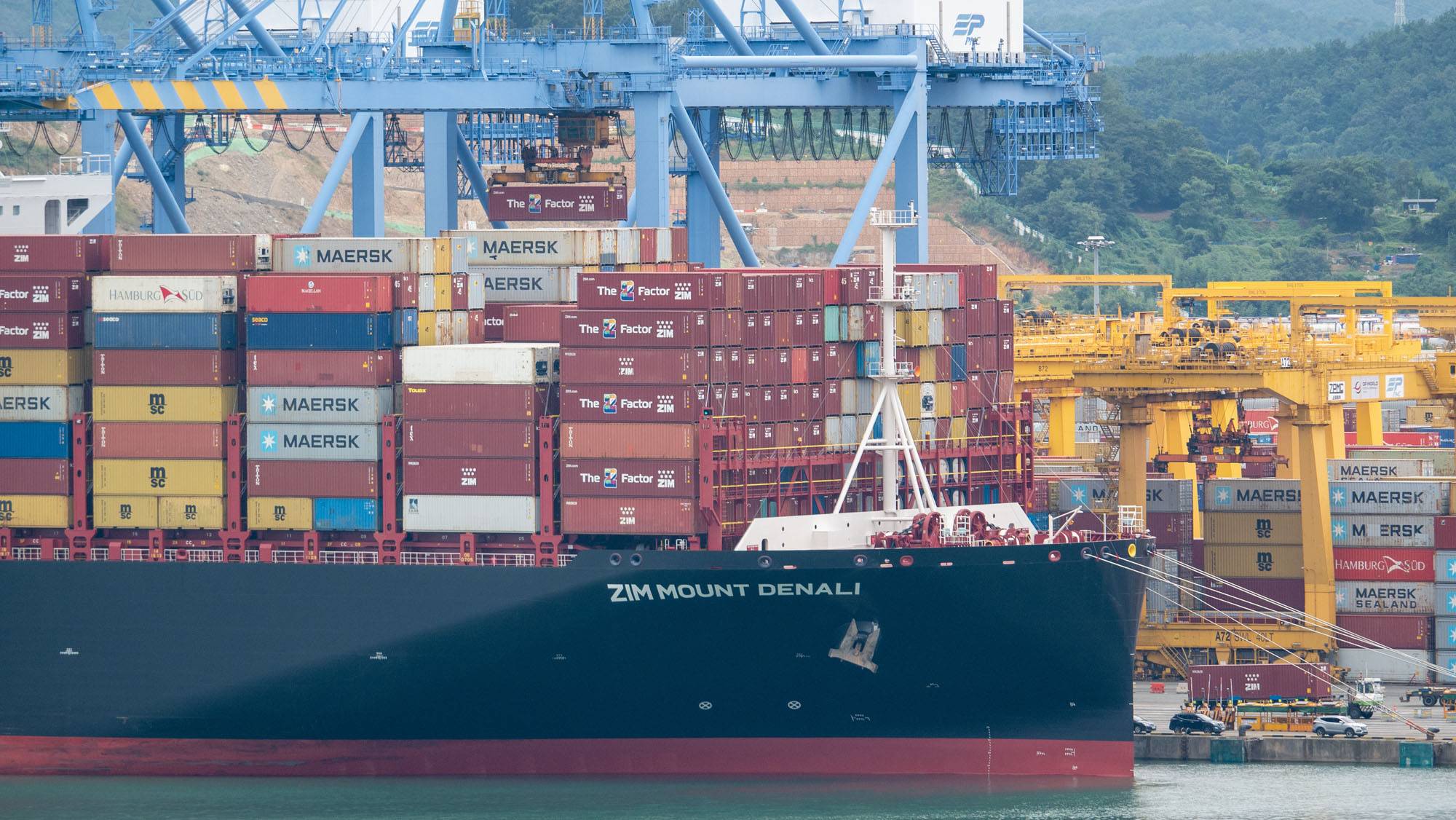
The container shipping sector continued its gradual normalization in 2025, and ZIM Integrated Shipping Services’ latest financial results offer a clear snapshot of the industry’s transition away from the extraordinary profits generated during the pandemic-era freight surge.
For the full year 2025, the Israeli liner carrier reported revenue of $6.9 billion, down from $8.4 billion in 2024 as freight rates softened across major trade lanes. Net income reached $481 million, a sharp decline from $2.15 billion the previous year, reflecting a market environment defined by falling rates rather than collapsing volumes.
Volumes, in fact, held relatively steady. ZIM transported 3.66 million TEU during 2025, only slightly below the 3.75 million TEU moved the year before. The primary driver behind the lower financial performance was freight pricing, with the average rate per TEU falling to $1,551 compared with $1,888 in 2024.
The fourth quarter mirrored the broader annual trend. Revenue for the final three months of the year came in at $1.48 billion, down 32% year-over-year, while net income totaled $38 million compared with $563 million in the same period a year earlier. Despite the decline, the company maintained solid profitability with adjusted EBITDA of $2.17 billion for the year and operating income of just over $1 billion.
The results reflect a container shipping market that continues to normalize following the extreme demand, port congestion and supply chain disruption that drove record earnings earlier in the decade. Even so, ZIM’s management highlighted operational discipline and fleet strategy as key factors that helped the company remain profitable despite the downturn in rates.
Central to that strategy is a highly flexible fleet model built largely on chartered vessels rather than owned tonnage. ZIM currently operates a fleet of 115 containerships totaling about 707,000 TEU of capacity, along with a small fleet of car carriers. The approach allows the carrier to scale capacity more quickly as market conditions change while limiting long-term capital exposure.
That flexibility remains evident in the company’s fleet renewal program. Over the past year, ZIM secured charter agreements tied to 36 newbuild containerships ranging in size from 3,000 to 12,000 TEU, representing approximately 250,000 TEU of additional capacity. Deliveries are expected to begin in the second half of 2026 and continue through 2028.
Among the vessels are a series of dual-fuel LNG-powered ships, reflecting the company’s effort to modernize its fleet while improving environmental performance and fuel efficiency. The incoming vessels are expected to help strengthen ZIM’s cost structure while supporting its “global niche” strategy—focusing on specific trade routes where the carrier believes it can maintain competitive advantages.
Even as earnings moderated, ZIM continued its strong capital return policy. The company declared a fourth-quarter dividend of approximately $106 million, bringing total dividend distributions tied to 2025 earnings to about $240 million, roughly half of annual net income.
Since its 2021 public listing, ZIM has returned an extraordinary $5.8 billion to shareholders through dividends, a figure that far exceeds the capital raised during the IPO.
While the company’s financial performance reflects a cooling container market, its strategic future may soon be shaped by consolidation. In February 2026, ZIM announced a merger agreement under which German liner giant Hapag-Lloyd will acquire the company for $35 per share in cash. The deal, approved by ZIM’s board, is expected to close by late 2026 pending regulatory approvals and shareholder consent.
The structure of the transaction includes a notable component aimed at maintaining Israel’s historic connection to the company. Under the arrangement, FIMI Opportunity Funds plans to establish a new Israeli-based liner operator, tentatively called “New ZIM,” which would operate vessels under the ZIM brand with commercial support from Hapag-Lloyd.
Until the transaction is completed, ZIM and Hapag-Lloyd will continue operating independently.
Looking ahead, the container carrier expects freight rates to remain under pressure in 2026 as new vessel deliveries across the global fleet weigh on supply-demand balance. Because of the pending merger, the company has opted not to issue formal financial guidance for the coming year.
Still, with a modernizing fleet, flexible charter strategy and potential integration with one of the world’s largest container carriers, ZIM enters the next phase of its history positioned to adapt to an industry that remains cyclical—but increasingly consolidated.


