

Report: Tanker Didn’t Stop After Trawler Collision
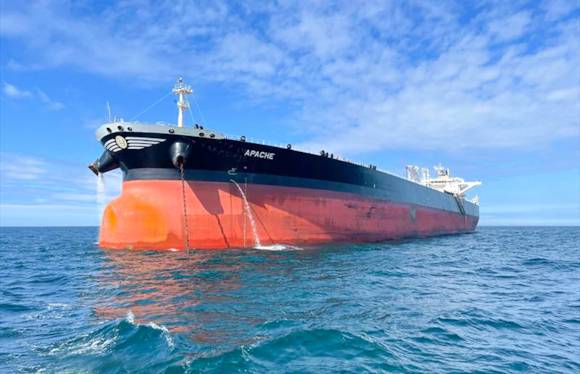
The UK Marine Accident Investigation Branch (MAIB) has released its investigation report into the collision between the crude oil tanker Apache and the stern trawler Serinah (GH 116) in the Firth of Clyde, Scotland on 25 April 2024.
At about 1503 on 25 April 2024, the crude oil tanker Apache and the stern trawler Serinah collided in the Firth of Clyde resulting in Serinah sinking rapidly. All three of the fishing vessel’s crew were able to abandon ship to the liferaft and were uninjured.
When the collision happened Serinah was fishing a seabed depression in the middle of the Firth of Clyde, making circular clockwise tows; Apache was inbound to the Finnart Oil Terminal and making preparations to board a pilot. Serinah sustained damage during the collision and sank rapidly.
All three of Serinah’s crew entered the water, two of whom quickly boarded an inflated liferaft. The skipper remained in the water for around 15 minutes before being rescued by the two crew in the liferaft.
Apache did not stop after the collision and continued towards the pilot boarding station until the crew were reminded by Belfast coastguard of their responsibility to render assistance to the crew of Serinah. By the time Apache’s fast rescue craft was launched Serinah’s crew had boarded their liferaft, from where they were taken ashore by a Royal National Lifeboat Institution lifeboat.
The investigation found that neither vessel took sufficient action to prevent a collision. Trained, experienced mariners on Apache did not act to follow the International Regulations for the Prevention of Collisions at Sea, 1972, as amended (IRPCS). The crew of Serinah had no formal navigation training, leading to them being unaware of their responsibilities.
The key safety issues identified were:
• Serinah sank when the damage it sustained during the collision with Apache was pushed beneath the water as Apache's bow ran over Serinah's towing wires, listing the boat to starboard.
• Apache and Serinah collided because neither vessel took sufficient action to avoid a collision in line with the IRPCS until it was almost inevitable.
• Assumptions about the intended actions of the other vessel and the perceived restrictive nature of the maneuvering area meant that no effective action was taken to avoid the collision.
• Serinah’s deployed fishing gear restricted the vessel’s ability to maneuver. When it became apparent that Apache was not going to alter course there was insufficient time for alternative collision avoiding actions to be taken.
• Serinah’s operator had not assessed the navigational risk associated with having inexperienced crew in charge of the navigational watch, exposing the vessel to a risk of collision.
• The mandatory training framework for fishermen did not ensure that those undertaking a navigation watch were qualified to do so safely.
Safety recommendations:
A recommendation has been made to the Maritime and Coastguard Agency to require skippers and watchkeepers on UK commercial fishing vessels between 7m and 16.5m to complete approved navigational training aimed at ensuring they are competent to hold a navigational watch in line with regulatory expectations.
Apache’s manager has been recommended to increase its understanding of global fishing vessel behavior and promulgate the information gained to its fleet.
Serinah’s operator has been recommended to ensure all crew expected to hold a navigational watch are sufficiently experienced and have a working knowledge of the IRPCS.
Chief Inspector of Marine Accidents, Andrew Moll, said: “This accident could have had a far worse outcome, and the investigation identified shortcomings in the navigational practices on both vessels involved. The report highlights that, despite being required by the International Regulations for Preventing Collisions at Sea (IRPCS) to give way, Apache’s master and officer of the watch assumed Serinah would turn away; a belief based on prior experience. However, neither vessel took sufficient action to avoid a collision until it was almost inevitable.
“Previous accidents show similar patterns, indicating that compliance with the IRPCS cannot be assumed or guaranteed. Ultimately, all vessels have a responsibility to act to avoid collisions, so in this report the MAIB is recommending that watchkeepers on small fishing vessels receive formal training in applying the IRPCS to help reduce the likelihood of such accidents in the future.”


