

Shipyard in Focus: Gladding-Hearn Shipbuilding


For Peter Duclos, shipbuilding has always been personal.
As President and Director of Business Development at Gladding-Hearn Shipbuilding, Duclos Corporation, Duclos represents the third generation of his family to lead the Somerset, Massachusetts, shipyard. “I’ve been involved with our family’s 70-year-old company my whole life,” he said. “From dinner table conversations to summer jobs, and now as President.”
Armed with a mechanical engineering degree from the University of Massachusetts and a U.S. Coast Guard master’s license, Duclos has played a direct role in the design, construction, and delivery of more than 180 commercial vessels during his career. His responsibilities span sales, marketing, pre-contract engineering, estimating, and strategic planning, which he shares with his brother, John Duclos (Co-President and Director of Operations), his sister Carol Hegarty (CFO), and a core team of about 80 highly skilled employees.
A Yard Built for Agility …
Founded in 1955, Gladding-Hearn occupies 6.5 acres on the Taunton River, with more than 60,000 sq. ft. of covered work space. The yard maintains all trades in-house, a key strategy Duclos said, for controlling cost, schedule, and quality — and supplements with skilled contractors when needed. It also boasts a full-service engineering and naval architecture department, enhanced through partnerships with outside designers.
The yard’s production pace underscores its capacity and versatility: an average of five new vessels annually, ranging from 50 to 165 feet, plus one to two major refit projects each year. Over the decades, Gladding-Hearn has delivered tugs, ferries, fireboats, police boats, pilot boats, and research vessels, building a reputation for innovation and customer focus.
… a Business Model Built on Listening
If there’s one project that exemplifies Gladding-Hearn’s approach, Duclos points to the 53-ft. Chesapeake-class pilot boat. Developed with Ray Hunt Design in 2002, the model has been a cornerstone of the yard’s portfolio, with 27 delivered to date.
“The Chesapeake class really shows what we do best,” Duclos explained. “We listen and learn from our customers and continuously improve our product. The basic design remains consistent, but each boat is tailored to meet specific pilot requirements. Over time, we’ve refined performance, efficiency, and arrangement.”
This iterative, customer-driven model has helped Gladding-Hearn stay competitive in a niche market where few builders can match its mix of flexibility and proven design.
The Trump Bump
For Duclos, the Trump Administration’s prioritization of shipbuilding and maritime matters represents a rare and welcome shift in national policy. “It’s really extraordinary and exciting to see,” he said. “We can’t recall ever seeing this much attention on the maritime industry and specifically shipbuilding.”
While acknowledging that much of the Maritime Action Plan is aimed at larger yards, Duclos hopes for a “positive trickle down” to small- and medium-sized builders like Gladding-Hearn. He is particularly encouraged by ongoing support for MARAD programs such as Title XI financing, the Capital Construction Fund, and Small Shipyard Grants.
“Training will be the most important part of growing the maritime industry,” Duclos said, noting that small companies often struggle to balance efficiency with sustained workforce development. “We’d like to see longer-term thinking when it comes to training grants. One- to two-year programs are helpful, but continuous training is what’s needed to really grow the workforce.”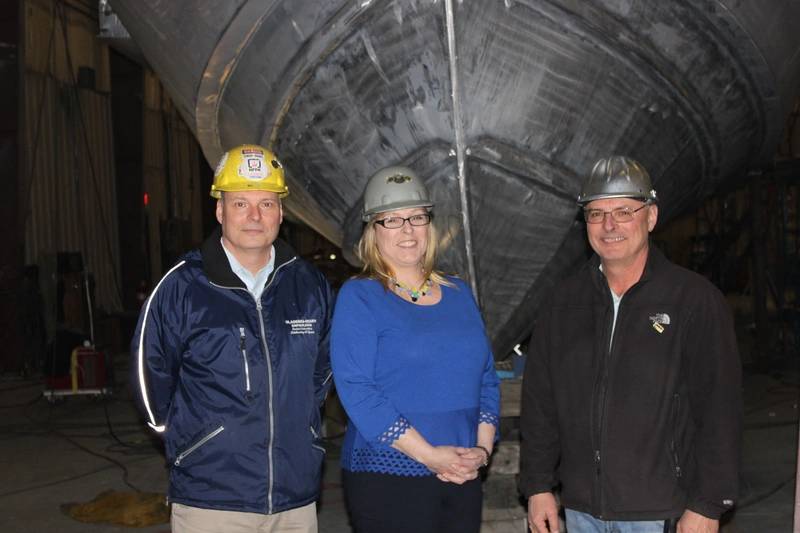 “The Chesapeake class really shows what we do best. We listen and learn from our customers and continuously improve our product. The basic design remains consistent, but each boat is tailored to meet specific pilot requirements. Over time, we’ve refined performance, efficiency, and arrangement.”
-Peter Duclos [left] President and Director of Business Development, Gladding-Hearn Shipbuilding, Duclos Corporation
Investing for the Future
Gladding-Hearn has leveraged MARAD’s Small Shipyard Grant Program to enhance its capabilities. Since 2008, the yard has secured four grants, enabling investments such as a welder training facility, a 35-ton yard transporter, 80-foot-wide fabrication shop doors, and a 60-by-45-foot sheltered plate yard.
“These upgrades make us more capable, compliant, and efficient,” Duclos said. “They’ve been instrumental in keeping our yard competitive in a challenging market.”
As Gladding-Hearn enters its seventh decade, Duclos sees opportunity in aligning the yard’s proven craftsmanship with a national push to revitalize the maritime sector. “It will be very interesting to see what happens in the next couple of years,” he said. “For shipyards like ours, even modest policy changes can have a big impact.”
Gladding-Hearn at a Glance
Founded | 1955
Location | Somerset, Massachusetts (6.5-acre facility on the Taunton River)
Workforce | ~80 full-time employees (plus contractors as needed)
Facilities | 60,000+ sq. ft. under cover, full-service engineering and naval architecture department
Production | 5 new vessels delivered annually (50–165 ft) + 1–2 major refits
Notable Product Line | 27 Chesapeake-class pilot boats delivered since 2002


